


by 

INVESTMENT PROJECT
Chemical fumigation of grain in vertical grain storage facilities without moving the grain using the automated robotic device
SGFOne – a self-immersing in grain fumigator!
SGFOne is a robot that autonomously penetrates the grain mass to a depth of up to 30 meters for grain fumigation and other operational tasks.
The project’s investment presentation can also be downloaded in PDF format from the page’s footer.
All rights reserved.
Grain storage facilities can be horizontal (single-storey warehouses) or vertical (silo-type grain storage facilities made of reinforced concrete or metal).
Vertical grain storage (silo type) is the most technologically advanced and has the highest productivity. Vertical grain storage facilities (grain silos) are the most common in the world. Grain storage heights typically range from 6 to 30 meters.
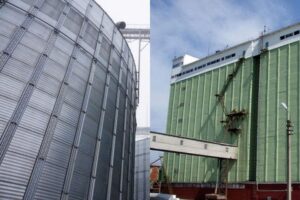
Grain silos (Vertical grain storage) facilities are grain storage systems that represent infrastructure that allows for the storage of significant volumes of grain and other bulk agricultural products. The main purpose of vertical grain storage is to protect and preserve grain from adverse environmental conditions, including pests.
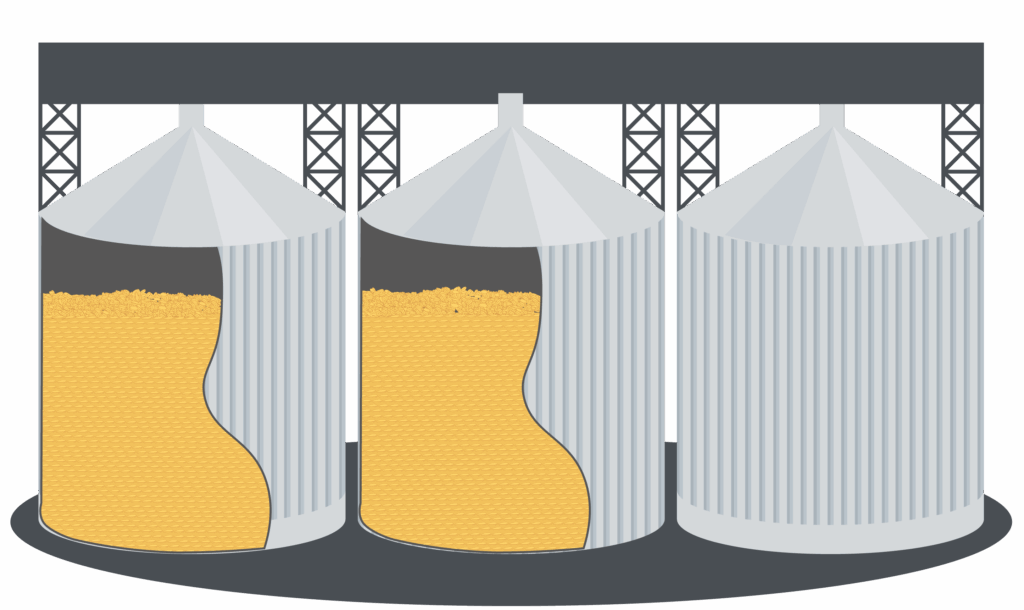
Grain production is growing steadily, as are global food production and consumption. Storage of food grains is an integral part of the agricultural system, and the preservation and storage of grains should ensure food security for humanity. The growth rate of construction of new vertical grain storage facilities is expected to increase by more than 5% per year. Grain storage silos require less space than horizontal warehouses, which is expected to contribute to the growth of vertical grain storage capacity in the coming years. North America and Asia Pacific are expected to hold the largest share of the global vertical grain bins and storage systems market by 2033. Priority for types of storage of agricultural crops in the world in vertical grain storage facilities: rice, wheat, corn, soybeans, sunflower, other types of crops.
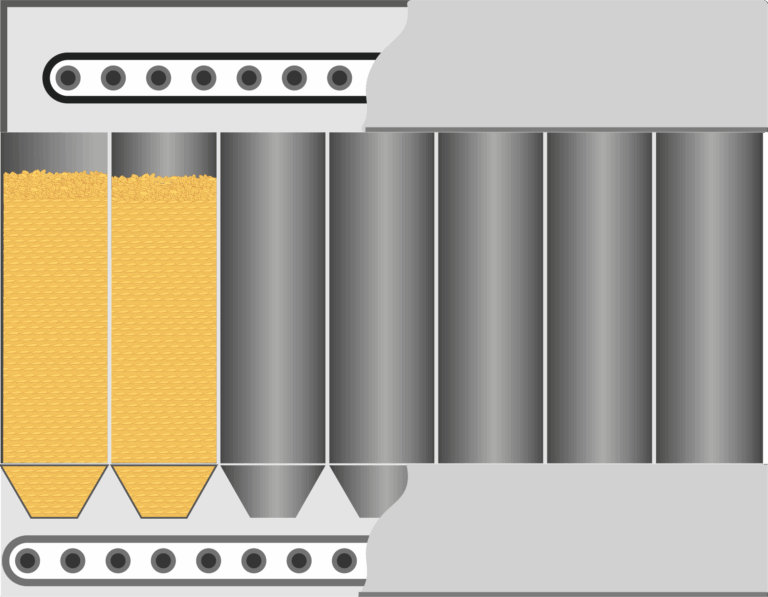
Fumigation—the control of grain pests—is an integral part of grain storage. Fumigation volumes will increase as grain storage volumes increase worldwide.
Chemical fumigation of grain during storage and transportation remains the most common and accessible method of protecting grain products in the global grain industry.
The main goals of SGFOne are to reduce environmental risks at fumigation, reduce the costs of chemical fumigation and improve the safety of fumigation in grain storage facilities, as well as reduce restrictions during fumigation through the use of robotics and automation.
Fumigation of grain crops is carried out after harvesting during storage in grain storage facilities.
A reinforced concrete silo grain storage building usually combines several silos (bunkers) for vertical storage of grain and has upper and lower technical rooms (upper and lower elevator galleries). Metal vertical grain storage facilities are metal single bin (tanks) or combined into a group and connected to each other by a common grain transportation system.
Using electrical grain elevator equipment: belt conveyors, auger loaders, pneumatic loaders, grain is loaded into the grain storage and moved for cooling in winter and for fumigation.
Grain fumigation is carried out at grain storage facilities at least once and more often during 6 months of storage.
Phosphine gas (PH3) is used for grain chemical fumigation – a highly toxic gas that penetrates the respiratory tract of pests, including hard-to-reach places inside the grain mass, Phosphine blocks cellular respiration, preventing oxygen absorption and normal oxidation processes. It also paralyzes the nervous system, leading to the loss of the ability to move and eat. As a result, the body’s vital functions cease, and the pests die.
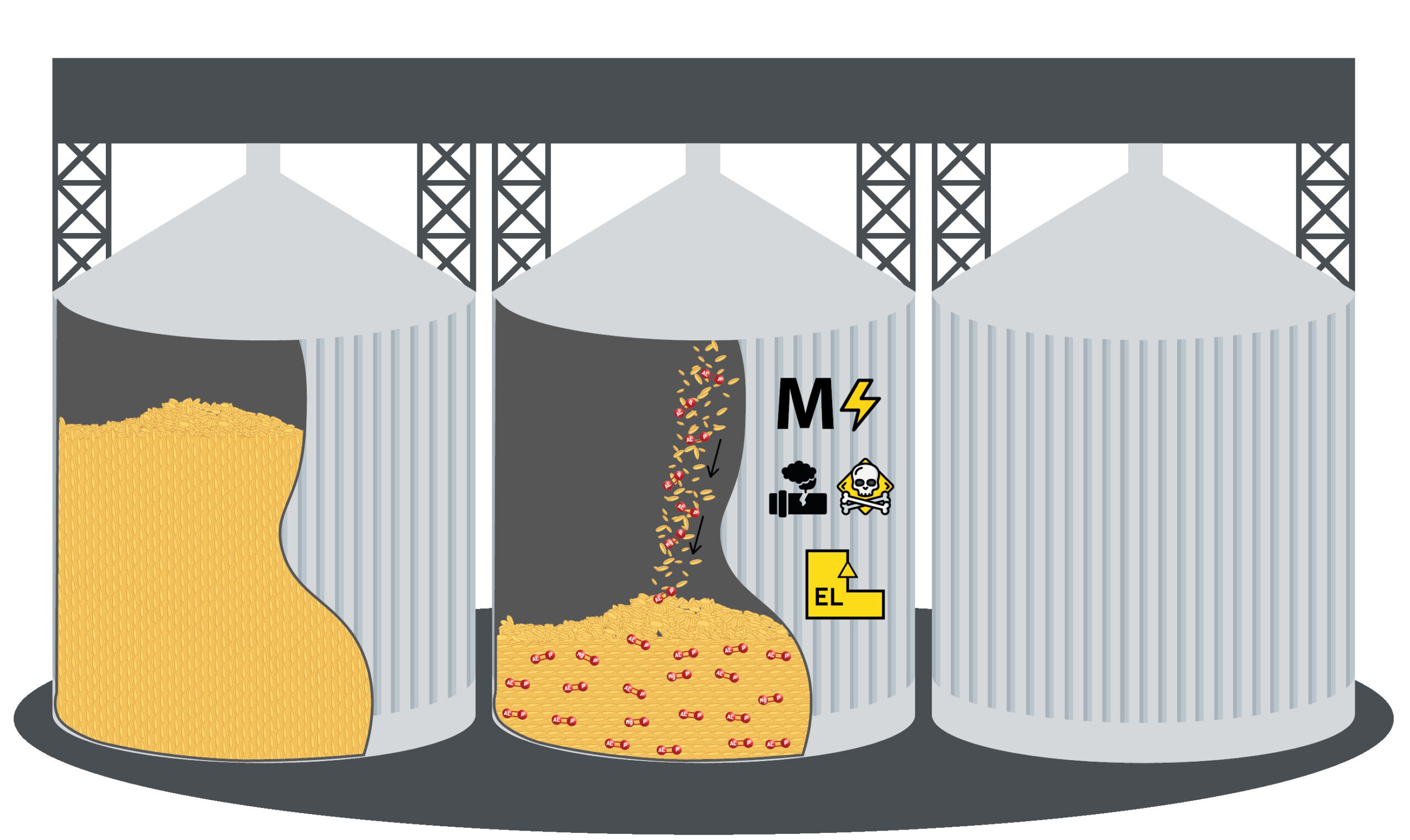
Although Phosphine gas is heavy, it usually sinks under its own weight no deeper than 1-2 meters into the grain, and to fumigate the entire volume of grain in the grain elevator, the grain is moved, lowering its level in the silo storage to 2 meters and re-pumping the grain, raising the level, adding solid phosphide (later changing to gaseous phosphine) layer by layer into the capacity of the grain storage bin.
Energy-intensive machinery and equipment are used to move grain into the grain storage facility. Due to gas diffusion, up to 20% of the phosphine unintentionally spreads into thegranaries technical rooms and beyond. This creates restrictions on the presence of personnel at the grain storage facility without protective equipment for a long period (the period of fumigation, exposure, and decontamination (forced ventilation of these premises) and limits the implementation of other technological work at the facility.
Fumigation is carried out with solid fumigants (in the form of spherical tablets, plates, flat tablets, granules) weighing from 3 grams, Aluminum Phosphide or Magnesium Phosphide, supplied by the manufacturer in sealed aluminum cans with an airtight lid.
Phosphide is introduced into the grain layers in the form of solid tablets (plates, granules), where, under the influence of moisture in the surrounding environment (in the grains and in the air between the grains), it reacts with the moist air to form gaseous Phosphine. One 3-gram aluminum Phosphide tablet releases approximately 1 gram of gaseous Phosphine.
Phosphine then spreads through the intergranular space through gas diffusion, typically sinking to a shallow depth. This is why it’s important to distribute the solid fumigant Phosphide evenly, layer by layer, throughout the grain, using a layer-by-layer method of introducing fumigants into grains in a vertical grain storage facility.
For example, in horizontal (floor) grain warehouses, where the height of grain storage does not exceed 3-5 meters, the introduction of solid phosphide fumigants is carried out manually by probing – using special fumigation probes (up to 2 m long), the fumigant is inserted and unloaded into the thickness of the grain to a depth equal to the length of the probe.
In conditions of great height (depth) of grain storage in vertical grain storage facilities (silos) up to 30 m, this method (the probe method) of grain fumigation is impossible. In vertical (silo) grain storage facilities, phosphide is introduced into the grain layer by layer, moving it from one bin to another, with the help of grain conveyors.
What are the disadvantages and risks of fumigating grain in a silo grain elevator using traditional fumigation methods?
DESCRIPTION
1. Full or partial movement of grain for fumigation is accomplished using elevator mechanisms and equipment.
Energy consumption of grain elevator equipment and labor costs are considered as a part of the technological process.
CLASSIFICATION, CONCLUSION
Economic disadvantages:
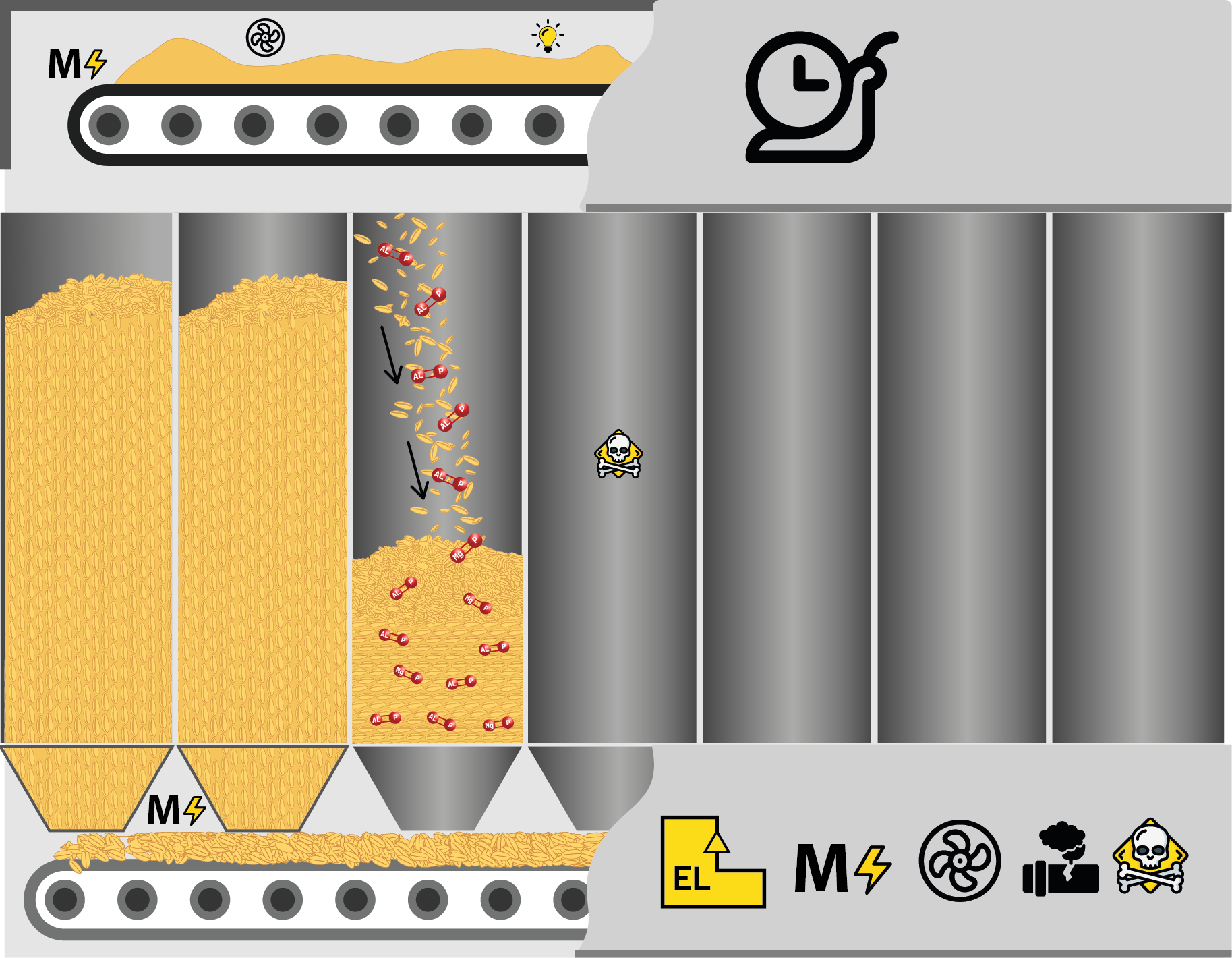
1.1. Energy costs associated with the operation of equipment, mechanisms, and lighting.
1.2. Labor costs associated with maintaining personnel to support the process.
2. Long-term fumigation of grain in silos is associated with the use of other elevator systems and mechanisms, time spent on moving or lowering the grain and reloading it into the silo, during which phosphides are simultaneously loaded into the grain layer by layer.
Economic disadvantages:
2. The duration of grain fumigation by the layer-by-layer addition of phosphides to the grain in the silo is determined by the sequence of technological operations in traditional fumigation technology and is proportional to the speed of grain movement (loading of grain into the bin).
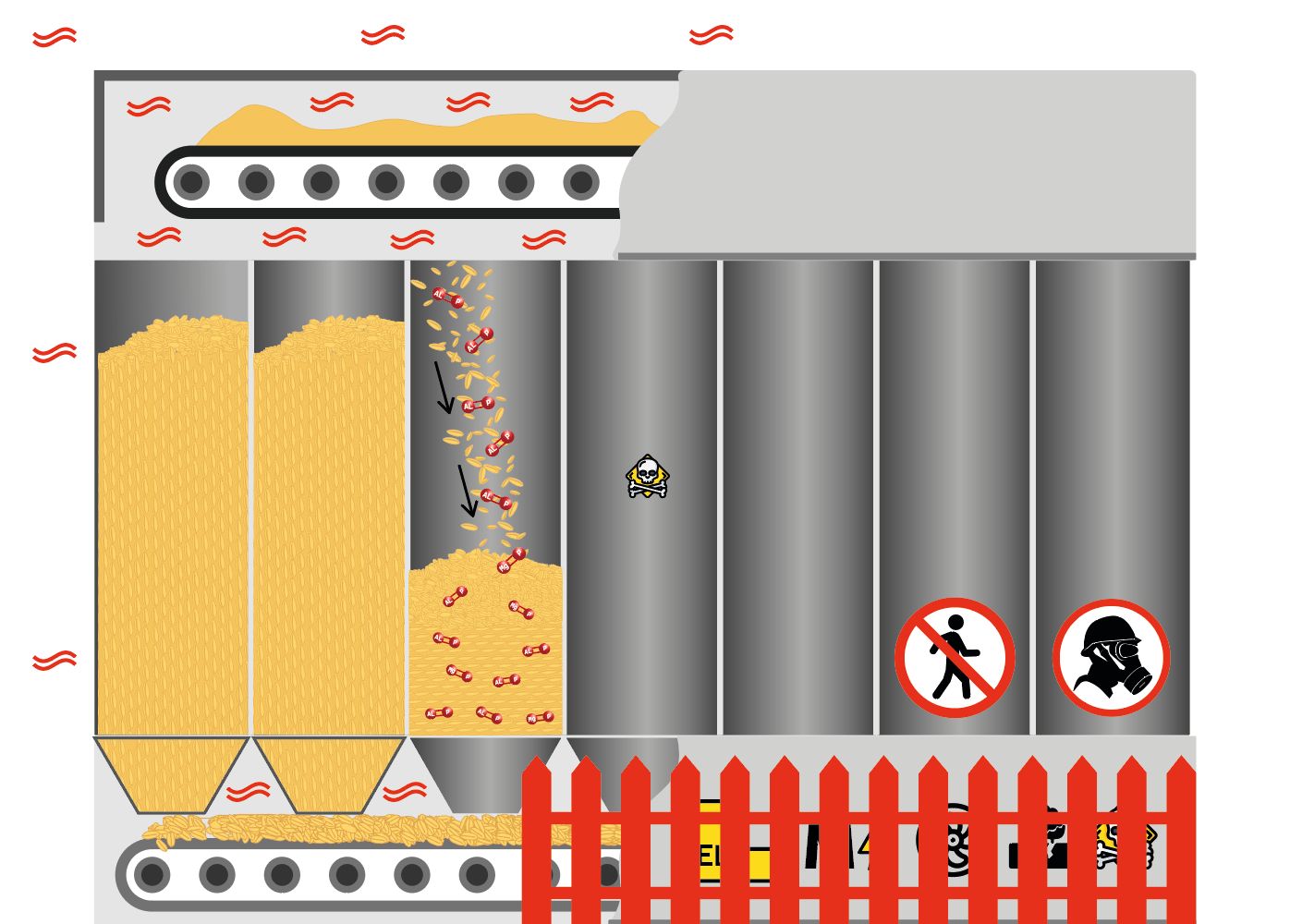
3. Downtime of the entire silo building of the grain storage facility, even those tanks in which grain fumigation is not carried out.
Restrictions on the operation of the entire grain storage facility.
Economic disadvantages:
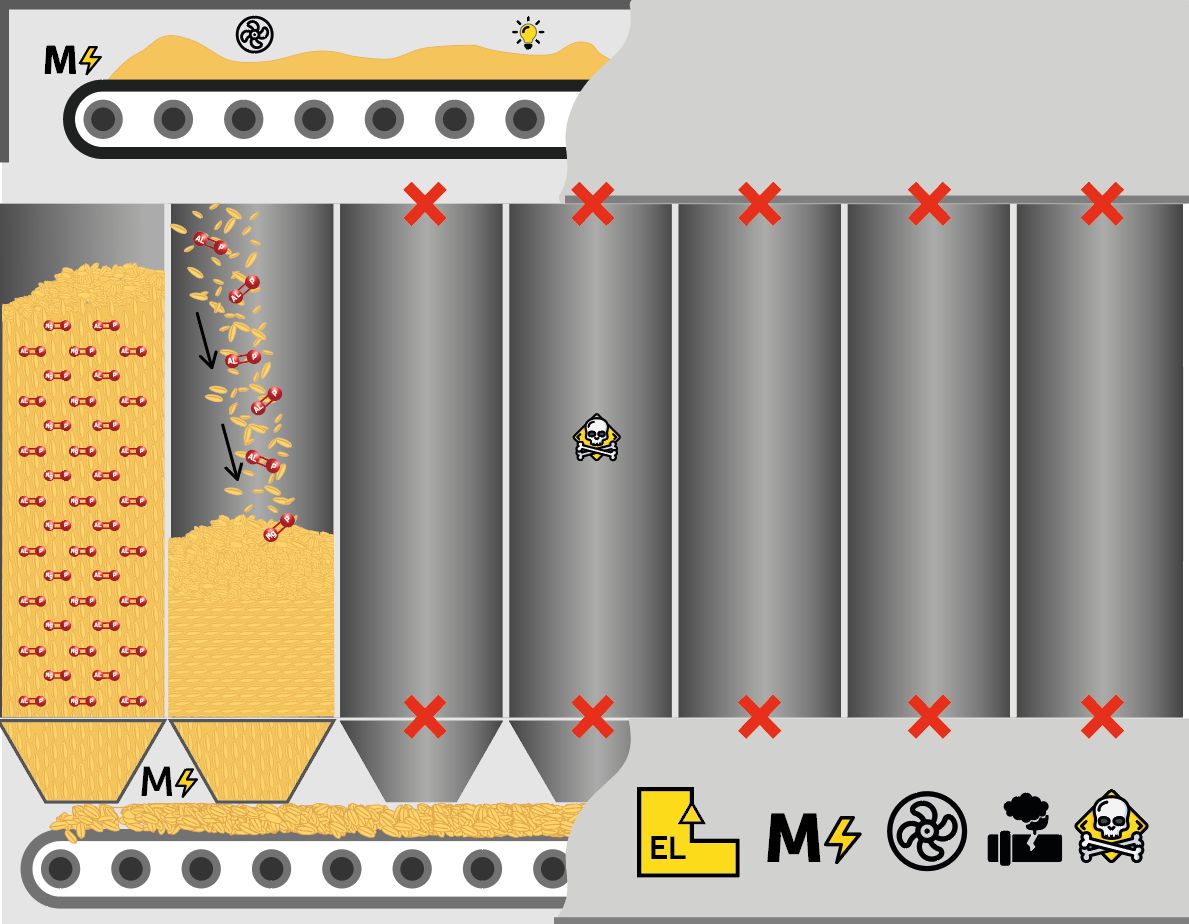
3. Vertical reinforced concrete grain storage facilities typically consist of 50 or more vertical tanks.
When fumigating grain in individual tanks, the entire grain storage building is used during grain pumping to lower the grain level in these individual tanks, and phosphine gases are distributed throughout the vertical grain storage facility by diffusion. Thus, performing other technological operations, even with unfumigated grain, becomes impossible. Fumigation of individual tanks (bin) establishes a quarantine for the entire grain storage building.
Selective, safe fumigation of individual grain tanks using traditional chemical fumigation methods is impossible.
4. Due to the continuous movement of grain and open loading of phosphines into silos (through a conveyor or hatches), there is an involuntary spread of phosphine gases (up to 20%) outside the grain storage facility under the influence of gas diffusion and wind.
Environmental risks, industrial hazards:
4. Phosphine gas leakage into other production areas of the facility (upper and lower elevator galleries), into the outdoor area of the facility, and into the surrounding environment.
5. High cost of fumigation works and high labor intensity of fumigation works (services)
Economic disadvantages:
5. High cost of fumigation services for the customer
6. During short-term storage of grain, sometimes focal fumigation of a separate section (layer) of grain is required where a concentration of pests has been noted, revealed by an elevated grain temperature at a certain depth.


Economic disadvantages:
6. Fumigation of a single source of contamination in a grain storage facility is impossible due to the technical impossibility of delivering the fumigant to a separate, designated point within a single storage capacity without moving the entire volume of grain in that storage capacity.
7. Loosening and aerating grain is an important process for preventing grain spoilage, helping to reduce humidity and temperature, prevent mold formation and self-heating of the grain.
Technically, this is achieved by supplying air to the grain bin using special equipment or by pumping (moving) grain from one silo bin to another, which requires additional energy and labor costs.
Economic disadvantages:
7. Loosening and aeration of grain is a separate technological process that requires the use of additional energy-intensive elevator equipment, technological time and labor costs.

New Possibilities in Chemical Fumigation of Grain in Vertical Grain Storage Facilities with SGFOne Technology
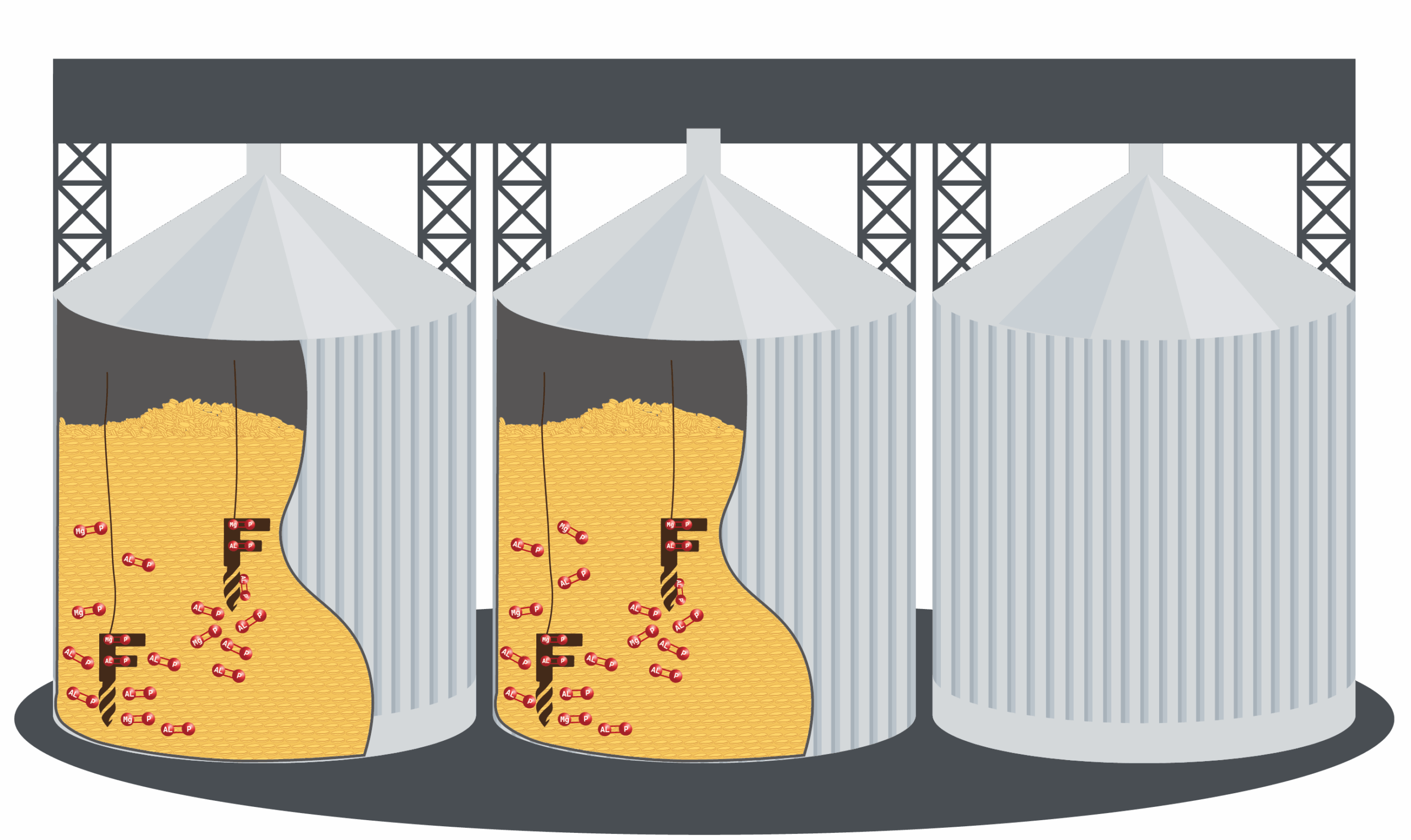
SGFOne – grain fumigation at specified coordinates, a new fumigation method involves fumigating with phosphides a specific target point in the thickness of stored grain – the source of contamination in the depth of stored grain in a vertical silo bin or layer-by-layer the entire volume of grain in a separate bin, without moving the grain, by a method of delivering phosphides to specified points in the grain thickness at any depth (height) of grain storage, by immersing the SGFOne device (phosphide loader) deep into the thickness of the grain.
Briefly about SGFOne® grain fumigation technology: There is no longer any need to move grain in vertical grain bins or lower the grain bed level during fumigation, use energy-intensive elevator equipment to move grain, isolate individual parts of the grain storage facility due to the spread of phosphine gases – The world’s first self-immersing grain fumigator SGFOne will dive into the grain layers to a specified depth (height) in the grain bin, deliver and unload the Phosphide fumigant at a specified point or throughout the entire bin (layer by layer) and return back.
Grain fumigation in silos with SGFOne:
1) Very economical: no energy consumption by the grain storage facility, no need to move or lower the grain level in the silos, no need to operate energy-intensive elevator equipment, no personnel required to maintain the grain storage facility during fumigation.
2) Very fast. No more moving grain: the grain fumigation rate in the silo is proportional to the vertical movement of the SGFOne Self-immersing Grain Fumigator within the grain. And on average from 200 tons of grain/hour to 900 tons of grain/hour.
Savings in production time and man-hours spent on fumigation as much as 10 times.
The SGFOne average vertical movement speed between layers of wheat grain in a silo is 1 meter per minute.
For example, the SGFOne can traverse a 30-meter-high silo in both directions (a 60-meter journey) and discharge phosphides layer by layer at specified points on average in 1 hour.
Thus, for a vertical silo of a reinforced concrete grain elevator with a height of 30 m, the grain fumigation rate is 200 tons per hour.
And this is just with one SGFOne device!
Or a 20m high, 18m diameter metal grain bin with a grain capacity of 5,000 tons, three SGFOne Self-immersing Grain Fumigators will fumigate in less than 6 hours, with an average fumigation rate of 840 tons per hour.
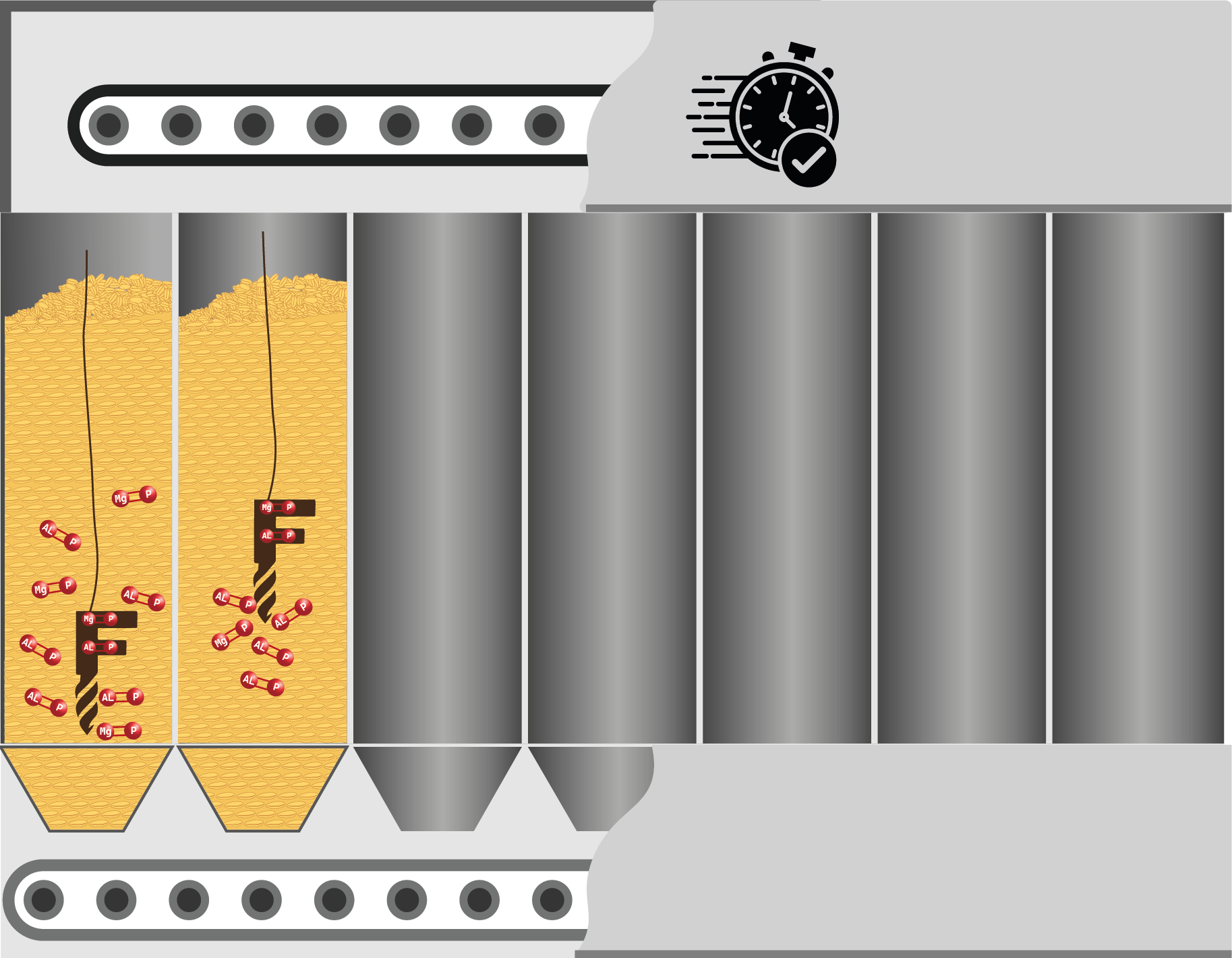
3) Now there will be no downtime for adjacent and neighboring tanks located in the same silo building.
Because the grain remains stationary and the phosphide fumigants are carefully delivered directly to the target point within the stationary grain in a single bin (other tanks and elevator systems are not involved), diffusion does not extend beyond the single fumigated bin.
4) Environmental risks are minimized, there is no grain movement, very precise delivery of phosphides inside the stationary grain, no diffusion of phosphines outside the grain bin.
5) With SGFOne you can selectively fumigate electively only one point in the grain, at any depth (height) of the silo,it is possible to fumigate only the source of infested stationary grain in the grain bin.
This is precisely what the Fumigation of Grain at Given Coordinates Method is all about.


6) The self-immersing grain fumigator SGFOne, when passing through the thickness of the grain for grain fumigation, spontaneously loosens the grain in the silo bunker over a radius of 1.5 m along the trajectory of vertical movement.
An additional function of the SGFOne is aeration of grain in the silo bunker. The SGFOne can be optionally equipped with an air duct, which is a set of perforated aluminum-magnesium alloy pipes connected to each other with special quick-release couplings for aeration of grain during immersion of the SGFOne for grain fumigation.
If necessary, the self-immersing SGFOne fumigator can insert an air duct (which passes through the grain along the vertical trajectory of the SGFOne path) into the grain to a depth of up to 30 meters. By connecting an air compressor to the air duct, the grain in the silo is aerated by forcing air into the air duct and the distribution of air under pressure in deep layers of grain in a silo bunker. Aeration of grain during fumigation is an additional function that requires additional time.
SGFOne Investment Project Presentation, PDF file
Tags: robot that burrows into grain, robot moving inside grain, innovative grain fumigation, modern grain fumigation, SGFOne, grain fumigation without moving the grain