


by 

I dedicate my invention and the SGFOne agricultural Project aimed at preserving, reducing costs and raising the quality standards of food supplies worldwide, as well as improving occupational safety and environmental performance in the grain storage industry, to the memory of my teacher and friend, professor and doctor of technical Sciences Andriy Golovchuk (1948-2017).
Dmytro Nedvyha

We apologize for the inconvenience, this page has not yet been written and is under reconstruction.
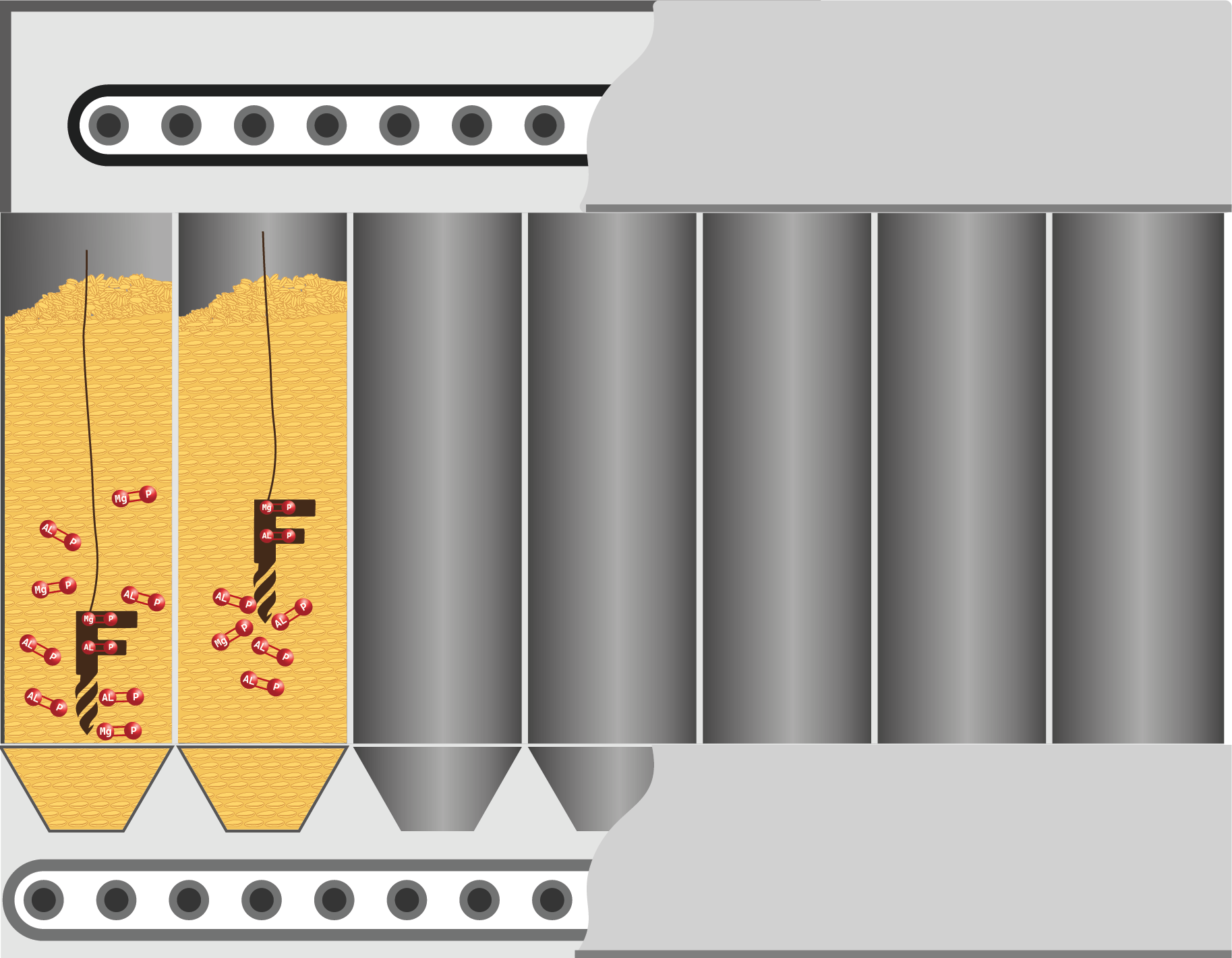
The operating principle of the SGFOne self-immersible grain fumigator is based on Dmytro Nedvyha Method of grain fumigation in given coordinates.
Bringing fumigants to statically stored grain in a full grain silo (to specified points of the filled grain bin), without movement of the grain itself, is much more practical and less expensive than adding fumigants to grain being pumped from one bin to another.
After developing the “Fumigation of Grain at Given Coordinates” method in 2006-2008, Dmytro Nedvyha and a group of Ukrainian scientists began implementing the technical component of the project—creating a robotic device capable of autonomously descending to the depths of a silo, deep into the grain, and also to deliver and unload phosphides into a filled grain bin.
The first prototype of the Self-Submersible Grain Fumigator was named GAF (Gas Automatic Fumigator). The device was developed under the supervision of Professor of Agriculture and Doctor of Technical Sciences, Rector of the Uman University of Horticulture (Ukraine) Andriy Golovchuk, together with Dmytro Nedvyha and Olga Orlova in 2008 and patented.
The device underwent extensive testing, but due to numerous technical shortcomings, it was never implemented for use in the grain industry.
However, it was the first device, which never saw the light of day, that laid the foundation for the introduction of the innovative method (at that time, a futuristic method of fumigation) “Of Fumigation of grain in given coordinates” and inspired the creation of the final, first-in-the-world device – a self-immersing grain fumigator.

Only in 2020, a second-generation point-of-use grain fumigation device was created –prototype (experimental sample) of the self-immersing grain fumigator SGFOne, called “SGFone Mite”, named after the grain mite (Siteroptes graminum), a pest that is particularly dangerous to grain during storage.
Due to the device’s wide, barrel-shaped body, its penetration depth into grain was limited to a maximum of 6 meters. Several experimental SGFone Mite devices have been released, successfully fumigating stationary grain in grain silos up to 6 meters high on a outside the laboratory. This device revolutionized pest control in vertical grain bins. It has also undergone extensive testing in vertical grain bins (for commercial purposes).
However, this wasn’t enough; the device wasn’t compatible with all existing types of vertical grain storage systems. The engineer was faced with the task of creating a universal robotic device for 30-meter-high silos.
A curious incident occurred one day—an emergency… The power supply and return transport cord of the SGFOne Mite experimental self-immersing grain fumigator, located at a depth of 7 meters, broke, and the device became stuck in the grain in the silo bunker. When pouring grain through the lower discharge neck, the device finally got stuck in the grain silo and blocked the discharge opening of the silo. Further grain unloading and dismantling of the device took several days. This incident was taken into account in the design of the subsequent SGFOne device.
In 2022, work on the device was completely suspended. War broke out in Ukraine, and innovative developments had to be stopped.
The project was only resumed in 2025. Together with a new contractor—a design firm specializing in robotics—the concepts for the final device of the world’s first self-immersing grain fumigator were developed.
The device received an additional option for aeration of grain throughout the entire depth of the grain storage facility, a gyroscope for positioning the device at a depth in the thickness of the grain silo, and a sensor for measuring the ambient temperature (grain at depth).
The device now incorporates true space technology—the concepts underlying some of its mechanisms could be used in geological studies of soils on other planets.
After all, Ukraine is the birthplace of this invention, and remains the flagship of the global rocket and space industry and a global producer and exporter of grain crops.
We sincerely hope that peace will soon return to our country. And we will find funding to complete our SGFOne Project.
